
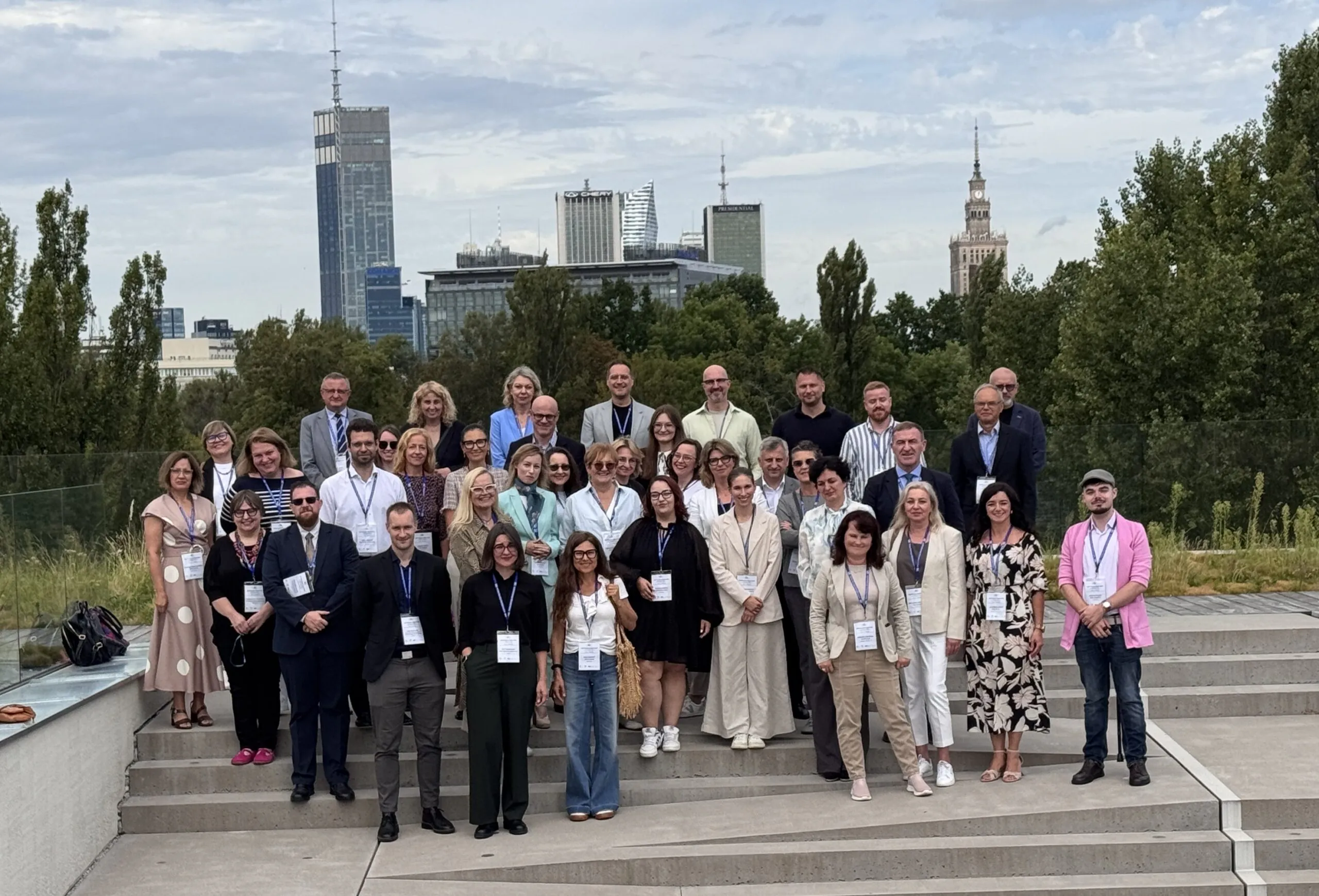
How can the common European criteria for the Joint European Degree Label be applied in practice? What evidence can demonstrate that they have been met, and how can consistent, well-reasoned judgements be formulated? These were the questions explored in Warsaw on 31 August 2026 by representatives of quality assurance agencies, higher education institutions and organisations involved in the development of European higher education. The international workshop was organised by the Polish Accreditation Committee (PKA).
The Joint European Degree Label – Technical Support Workshop: Interpreting and Applying the Operational Guide took place at SGH Warsaw School of Economics. Commissioned by the European Commission and delivered by PPMI (Verian Group) and ICF, the training brought together 40 participants and three trainers.
The Warsaw workshop brought together members and experts of PKA, representatives of Polish higher education institutions, the Polish Ministry of Science and Higher Education, the Foundation for the Development of the Education System (FRSE), EURASHE and Frontex, as well as representatives of quality assurance agencies from Bulgaria, Croatia, the Czech Republic, Romania, Slovakia and Sweden.
From criteria to well-reasoned judgements
Practice was at the heart of the workshop. Working in groups, participants focused on interpreting the Joint European Degree Label criteria, identifying appropriate evidence and formulating consistent, well-reasoned judgements. They analysed concrete cases, compared different interpretations of individual requirements and shared experience from different national quality assurance systems.
An important part of the discussion also concerned the links between the Joint European Degree Label, the European Approach for Quality Assurance of Joint Programmes and Erasmus Mundus Joint Masters, as well as the scope for building on existing procedures, documentation and experience from previous joint programme evaluations.
The practical nature of the workshop and the opportunity to compare different perspectives directly were among the aspects most frequently highlighted in participants’ feedback after the event. Particular value was placed on the joint interpretation of the new European criteria, the exchange of experience between agencies and higher education institutions, and dialogue across national higher education systems.
A shared European perspective
The workshop was preceded by a welcome reception hosted by the Polish Ministry of Science and Higher Education. Participants included Maria Mrówczyńska, Secretary of State at the Ministry, and Janusz Uriasz, President of PKA.
The Warsaw meeting forms part of wider European efforts to support the development of joint programmes and the implementation of the Joint European Degree Label. The initiative was one of the important topics addressed during the Polish Presidency of the Council of the European Union in the first half of 2025. In May 2025, the Council of the EU adopted documents establishing a basis for the implementation of the European label and setting out further steps towards the possible introduction of a Joint European Degree.
For higher education institutions, these developments open up new opportunities to design and deliver joint programmes with international partners. For students, they provide broader access to education in an international environment. For quality assurance agencies, they highlight the need for a consistent understanding of the European criteria and for a transparent and coherent approach to applying them in the evaluation of joint programmes.
Building on PKA’s experience
For the Polish Accreditation Committee, the workshop marked another step in building its expertise in the European quality assurance of joint programmes.
PKA coordinated the Erasmus+ ImpEA project, which focused on the practical implementation of the European Approach for Quality Assurance of Joint Programmes. PKA continues to apply the solutions developed through the project in its work and has already carried out evaluations of three international joint programmes – BASUS, PATHS and CLIDE – in accordance with the European Approach.
The Joint European Degree Label workshop builds on this experience by extending PKA’s expertise to another element of the emerging European framework for joint programmes. Developing these competences strengthens PKA’s capacity to provide robust quality assurance for emerging forms of transnational education and to support Polish higher education institutions seeking to develop high-quality joint programmes and participate actively in European academic cooperation.
We thank the Polish Ministry of Science and Higher Education for its cooperation, SGH Warsaw School of Economics for its hospitality and for providing a space for joint work, PPMI and ICF for delivering the training, and all participants for their engagement, open discussion and exchange of experience.


